

Beard growth is often framed as genetics or luck. That framing is simple, but it is incomplete.
Beard growth follows a biological process that is slow, cyclical, and heavily influenced by time, age, and behaviour. Most frustration comes from misunderstanding that process, not from a lack of ability to grow a beard.
What makes this difficult to accept is that the face looks like a single surface, so we expect it to behave like one. In reality, it behaves more like a collection of small, semi-independent zones.
Each follicle has its own sensitivity threshold, its own response to hormones, and its own growth ceiling. Some follicles are primed early. Others require years of cumulative androgen exposure before they behave like full terminal hair producers.
This is why early growth often looks chaotic rather than gradual. It is not that the beard is slowly filling in everywhere. It is that different areas are waking up at different speeds.
Once you understand that, uneven growth stops feeling personal.
This guide explains how beard growth actually works, why it feels uneven for so long, and what matters if you want to grow a beard without fighting your own biology.
Beard Hair Does Not Grow Together
One of the first mistakes men make is assuming beard hair grows as a unit.
It does not.
Each hair grows from its own follicle, on its own schedule. At any given moment, some hairs are growing, some are resting, and others are preparing to shed.
This is why early beards look inconsistent. It is not a failure. It is desynchronisation.
Understanding this removes a lot of unnecessary anxiety.
The Beard Hair Growth Cycle
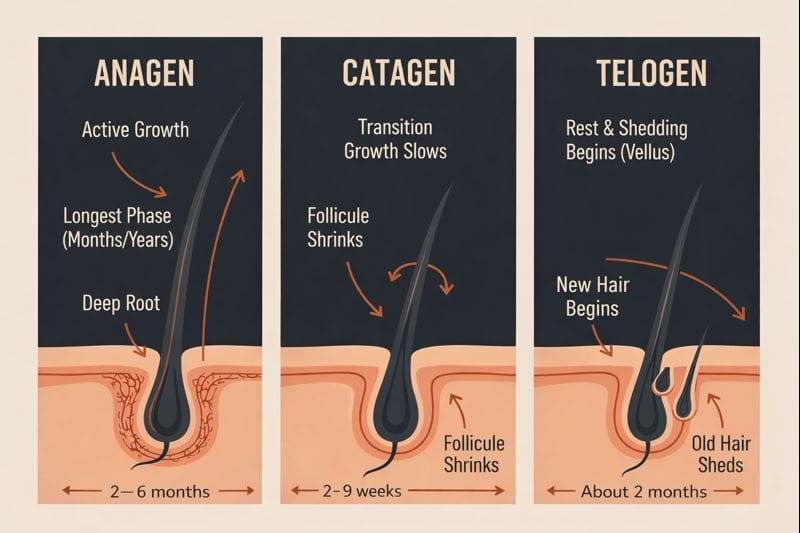
Beard hair follows the same three-stage cycle as other terminal hair. What differs is the duration of each stage and the unevenness with which follicles progress through them.
Anagen. The Growth Phase
Anagen is the active growth phase.
During this stage, the follicle produces hair continuously. For beard hair, anagen length varies widely between follicles. Some hairs grow for months. Others stop much earlier.
This variation is normal. It explains why early beards feel thin, uneven, or unpredictable.
Short anagen phases do not mean poor genetics. They often mean immature follicles.
Another detail that is rarely mentioned is that the length of each phase is not fixed.
Two follicles can both be in anagen while producing very different results. One may grow thick, dark hair for months. Another may stop after a short burst. This variability is why beard density cannot be judged early.
The growth cycle also explains why improvement often comes in waves. Men will experience periods where the beard seems unchanged, followed by sudden visible improvement weeks later. The work was happening below the surface first.
Growth is delayed feedback.
Catagen. The Transition Phase
Catagen is the shutdown phase.
Growth slows, and the follicle detaches from its blood supply. This phase is brief and usually invisible, but it explains why some hairs stop growing while others continue to grow.
Nothing has gone wrong when this happens.
Telogen. The Resting Phase
Telogen is the resting phase.
The hair remains in place before eventually shedding. Shedding is not regression. It is part of renewal.
Most men misinterpret normal shedding as beard loss. It is not.
Why Beard Growth Feels Uneven
Uneven growth is not a flaw. It is the default.
Different parts of the face have different follicle density, different hormone sensitivity, and different growth timing. The jaw and chin usually mature first. The cheeks often lag. The moustache can mature early. The neck is commonly last.
This imbalance corrects itself slowly, not suddenly.
I have found that many men quit or reshape their beard just before this synchronisation begins.
Patchiness Is Usually a Timing Issue
Patchy growth causes more abandoned beards than any other concern.
The usual advice is to wait. That advice is correct, but incomplete.
Most early patchiness comes from follicles producing vellus hair rather than terminal hair. These follicles are active, but not yet mature.
That transition depends on:
- Androgen exposure over time
- Age
- Consistency, not stimulation
This is also why shaving or trimming does not fix patchiness.
Cutting hair changes appearance, not follicle behaviour. A follicle that is not ready to produce terminal hair will not suddenly do so because the surface hair was removed.
I have seen men repeatedly shave in the hope of forcing density, only to delay the very thing they want by never allowing time under uninterrupted growth.
Patchiness resolves through exposure and patience, not reset cycles.
No oil, brush, supplement, or technique can force a follicle to mature faster.
Time does that.
Age Plays a Bigger Role Than Expected
Beard growth continues to develop long after adolescence.
Many men assume their beard potential was fixed in their late teens or early twenties. That assumption is wrong.
Facial hair density and coverage often continue improving into the mid-thirties and beyond. This is why beards grown later in life often appear thicker, darker, and more connected.
If your beard grows better now than it did years ago, that is biology, not imagination.
This gradual improvement with age often surprises men because it contradicts how we think about hair loss on the scalp.
Scalp hair tends to miniaturise with age. Beard hair often does the opposite. It thickens, darkens, and connects.
That contrast leads many men to assume something is wrong when their beard does not match their expectations early on. In reality, the beard is still maturing long after other hair patterns have stabilised.
This is one of the reasons late starters often end up with stronger beards than early growers.
Testosterone Is Overemphasised
Beard growth is frequently blamed on low testosterone. In most cases, this is a misdiagnosis.
If testosterone levels alone dictated growth, every man with a “normal” lab result would produce the same beard. They do not. The limiting factor is rarely the supply of hormones; it is the response of the follicle.
What matters is androgen sensitivity. Two men can have identical hormone levels, yet one will have a full beard while the other has sparse coverage. This is because their follicles respond differently to the same signal. Sensitivity is a genetic trait that you cannot measure at home or meaningfully manipulate with supplements.
Chasing testosterone optimisation purely for beard growth is a misplaced effort. If raw hormone levels were the primary driver, beards would not improve steadily as men age and their testosterone naturally begins to decline. Instead, we see the opposite. Beards often thicken and connect in the thirties precisely because the follicles have finally had years of cumulative exposure to the hormones already present.
Understanding this saves you from chasing “fixes” that address the wrong constraint. Focus on the timeline, not the chemistry.
The Awkward Phase Is Structural
The awkward phase is not cosmetic.
It occurs when hair is long enough to bend but not long enough to lie flat. This creates an uneven appearance, increased itch, and heightened self-awareness.
The most common mistake at this stage is trimming or reshaping too early.
Every time the length is reset, the awkward phase restarts.
The awkward phase ends through length, not control.

Beard Growth Is Slower Than It Feels
Beard hair grows at roughly half an inch per month.
That figure creates frustration when paired with daily mirror checks. Progress is measured in weeks, not days. Visual improvement lags behind actual growth.
Men who succeed are not more disciplined. They are more patient.
Grooming Products Do Not Create Growth
This is where IronMane challenges common advice.
You will often hear that oils stimulate growth, that washing less thickens hair, or that brushing activates follicles.
None of these will create new growth.
What they do is reduce friction, inflammation, and breakage. That helps preserve the hair you already have.
Supporting the environment is not the same as stimulating growth.
The grooming industry benefits from blurring the line between support and stimulation.
Supporting the skin reduces irritation, dryness, and breakage. That improves comfort and appearance. It does not instruct follicles to change behaviour.
When men expect products to create growth, they overuse them, change routines too often, and lose trust in the process when nothing dramatic happens.
Good grooming is maintenance, not activation.
That distinction is what keeps expectations realistic.
This distinction matters.
Nutrition and Hydration Are Baselines
Good nutrition supports normal biological function.
It does not unlock hidden beard potential.
Correcting a deficiency helps. Excess intake does not. Hydration keeps skin functional. It does not signal dormant follicles to activate.
I see many men chasing optimisation instead of consistency.
Stress, Sleep, and Beard Outcomes
Chronic stress affects beard growth indirectly.
It disrupts sleep, increases inflammation, and interferes with recovery. Over time, this can shorten growth phases and increase shedding.
The effect is gradual, but real.
Beard growth responds best to stability, not intensity.
Why Comparison Undermines Progress
Comparing your beard to others is misleading.
Most beards look incomplete early on. Online photos usually show months or years of growth, often shaped and styled.
Comparing week-six growth to long-term results leads to false conclusions.
Measure progress against your own timeline.
What Actually Improves Beard Growth Results
There are no shortcuts, but there are priorities.
Most men want a single lever they can pull.
In practice, beard growth improves when several boring factors line up and stay consistent long enough to matter. None of them feels dramatic. All of them compound.
This is why advice that sounds exciting usually underperforms advice that sounds dull.
Beard growth rewards patience far more reliably than effort.
Everything else is secondary.
This is not exciting advice. It is reliable advice.
Why Most Beards Fail Between Weeks Four and Eight
There is a narrow window where most beards are abandoned.
Hair is long enough to itch, bend, and look uneven, but not long enough to settle. Density looks worse before it looks better. Self-consciousness peaks.
This is also the stage where men intervene the most. They trim, reshape, over-wash, or reset length entirely.
From a biological perspective, this is the worst moment to interfere. Follicles are still synchronising. Length is doing the work that tools cannot.
Most successful beards are not grown by men with better genetics. They are grown by men who do nothing at the right time.
When to Intervene and When to Leave It Alone
Early growth rewards restraint.
Intervention becomes useful once length stabilises, coverage improves, and natural shape emerges. Before that point, most action causes setbacks.
Many failed beards are overmanaged.
Beard Growth Is a Long Process
A strong beard develops slowly.
Not because it must, but because biology does not respond to urgency. Men who understand this stop fighting the process. They experience less frustration and better outcomes.
That is the difference between growing a beard and constantly restarting one.
Final Perspective
Beard growth is not mysterious. It is misunderstood.
When you understand the cycle, respect the timeline, and stop chasing stimulation, growth becomes predictable.
Not fast. Predictable.
That is where patience stops feeling passive and starts feeling deliberate.