

Beard butter, beard balm, and beard wax are often treated as a simple ladder of strength. The common assumption is that as your beard gets longer, you graduate from butter to balm and eventually to wax.
This is a mistake.
These beard products are not different levels of the same thing. They are different tools, built on different ratios of oils, butters, and waxes. One prioritises the biology of the hair and skin. Another prioritises the architecture of shape and control.
Understanding those ratios saves you from the most common grooming frustration: a beard that looks styled but feels like dry Velcro.
Why These Products Get Confused
Most beard products are made from the same three building blocks.
- Carrier oils for slip and lubrication
- Butters for softness and flexibility
- Waxes for structure and hold
Marketing blurs the lines because “all-in-one” sounds like a better value. In formulation terms, everything is a trade-off. You cannot maximise deep softness and firm hold in the same tin.
Once you stop reading labels and start paying attention to texture and behaviour, the confusion disappears.
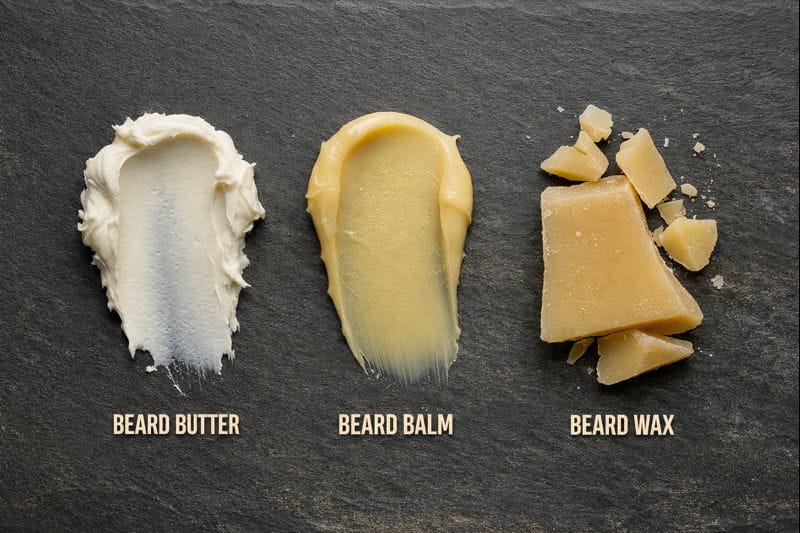
What Is Beard Butter?
Primary role: softness, conditioning, and skin comfort.
Beard butter is a leave-in conditioner in semi-solid form. It is high in fats and carrier oils, with little to no wax. It is designed to melt on contact and absorb into the hair and skin rather than sit on the surface.
This makes it most useful when dryness, itch, or stiffness is the main problem rather than shape.
IronMane Insight:
Beard butter has zero memory. If hairs are sticking out, butter will not tame it. It will only make them softer. This is why butter works best at night, during early growth, or when comfort matters more than appearance.
What Is Beard Balm?
Primary role: light control plus conditioning.
Beard balm sits between care and styling. It contains enough wax, usually beeswax, to add weight and direction, while still relying on butters and oils to keep the beard flexible.
It does not lock hair in place. It helps the beard behave as a single unit instead of a collection of individual flyaways.
IronMane Insight:
Balm is about restraint, not rigidity. Think of balm as everyday gear rather than special-occasion styling. In practice, it becomes the daily driver for most medium-length beards because it improves shape without sacrificing comfort.
What Is Beard Wax?
Primary role: firm hold and structural shape.
Beard wax is a styling product first. It is dense, tacky, and high in wax content. It is not meant to absorb. It is meant to coat the hair and create a physical bond that holds stubborn growth in place.
Conditioning is secondary.
IronMane Insight:
Wax prioritises control over comfort. It is situational. Use it for strong winds, formal shaping, or very long beards. Use it daily without proper cleansing, and you invite buildup, irritation, and follicle inflammation.
The Differences That Actually Matter
This breakdown matters because choosing the wrong product not only fails to help but also creates new problems.
| Feature | Beard Butter | Beard Balm | Beard Wax |
|---|---|---|---|
| Primary goal | Deep conditioning | Light shaping | Firm structure |
| Absorption | High, into hair and skin | Moderate | Low sits on the surface |
| Texture | Creamy or whipped | Firm but spreadable | Sticky or hard |
| Hold level | None | Low to moderate | High |
Stronger hold is not an upgrade. It is a trade-off.
The Hidden Trade-Off: The Wash-Out Cost
One practical detail many guides ignore is what happens after the product is on your face.
The more wax a product contains, the harder it is to remove. Butter rinses out easily. Balm needs light cleansing. Wax requires a proper beard wash.
If you use a heavy wax daily and rely on water alone, wax traps dirt, oil, and dead skin against your face. More hold always demands more hygiene.
Common Mistakes: Matching the Wrong Tool to the Job
The early wax error:
Using wax on a one-month beard is like putting a roof on a house with no walls. You add weight to a foundation that does not exist yet. The result is stiffness and highlighted patchiness.
The butter stylist:
Expecting butter to fix flyaways. The result is a soft, greasy, untidy beard.
The buildup trap:
Adding more balm because the beard looks dry, when old wax is blocking moisture from getting in. The fix is washing, not more product.
Most beard problems blamed on genetics are tool-selection problems.
How to Choose Without Overthinking It
Use function, not marketing language.
If your beard is dry, itchy, or you are going to bed, use butter.
If you want your beard to look neat and controlled during the day, use balm.
If your beard is long, stubborn, or refuses to stay down, use wax.
Many men use different products at different stages. That is normal. The mistake is treating hold as progress.
The Takeaway
Stop chasing strength as an upgrade. A stronger product is not a better product. It is simply built for a different job.
When you match the tool to your beard’s current length and texture, grooming stops feeling like a fight and starts feeling deliberate.