

Low-maintenance beard styles are not about doing nothing. They are about choosing a shape that works with your growth pattern, your face, and your tolerance for upkeep.
Most beard frustration comes from picking a style that demands daily correction. Sharp lines, carved cheeks, and fighting patchy growth all add friction. A low-maintenance beard removes that friction by design.
What “Low-Maintenance” Actually Means
Low-maintenance does not mean unkept. It means a beard that:
- Tolerates uneven growth rates
- Does not rely on surgical precision to look intentional
- Holds its silhouette even when you miss a week of grooming
The key is choosing a beard that forgives neglect without looking neglected.
Understanding which styles are naturally forgiving is easier if you know how different beard styles are defined in the first place. That broader context is covered in Beard Styles Explained: A Practical Guide to Popular Beard Types, which breaks down the structure behind common styles before you simplify them.
1. The Heavy Stubble (around 5mm–10mm)
Stubble is the ultimate low-maintenance style because it is too short for gravity or curl to take over.
The low-maintenance secret: it is a one-tool beard. You do not sculpt stubble. You reset it.
The trade-off: you trim more often, usually every three to four days, but each session takes minutes.
Stubble is maintenance-light, not maintenance-free. Leave it for two weeks and it enters the scrubby phase, where it looks accidental rather than deliberate.
This works on most face shapes and is especially forgiving if your growth is uneven.
2. The Soft-Boxed Beard
A short boxed beard becomes high-maintenance the moment you chase sharp cheek lines. The low-maintenance version ignores the drawn-on look.
The play: keep the length uniform along the jaw, but let the cheek line stay natural. Instead of a cliff-edge, you create a soft transition.
Why it works: when the cheek line is natural, a few stray hairs do not ruin the look. You stop chasing the line every morning.
This approach works particularly well on oval and square faces, where natural bone structure already provides definition.
3. The “Sit and Settle” Medium Beard
Left alone past the early awkward phase, many beards begin to settle.
The play: let the hair grow long enough, roughly one to two inches, that its own weight pulls it downward.
Why it works: Length acts as a shield, but it also provides ballast. The weight of the hair does the work that your trimmer used to do. It fills in patchiness visually and softens the neckline. You move from shaping to bulk management.
This style demands patience, not precision. Once established, you are trimming flyaways every couple of weeks, not rebuilding the shape.
Most men abandon this stage too early, then assume it never worked for them.
4. The Beardstache (Short Beard, Strong Moustache)
The beardstache works because it lowers expectations on the beard itself.
The play: keep the beard at heavy stubble length and let the moustache carry the weight.
Why it works: the moustache provides character and balance. Patchy cheeks or a wandering neckline matter less because the beard is clearly the background structure.
This style suits lighter beard density and works well on round or triangular faces, where the focus at the centre of the face adds balance.
The Hidden Trap: Styles That Look Easy but Aren’t
Do not confuse clean with low-maintenance.
Styles that rely on high contrast are almost always high effort.
- Fades: they look sharp for forty-eight hours. By day three, the gradient is gone, and the beard just looks messy.
- Carved cheeks: the moment stubble appears above the line, the beard looks dirty rather than natural.
If a style only looks good when freshly trimmed, it is not low-maintenance. It is time-sensitive.
The Silhouette Over Symmetry Rule
Low-maintenance is about the silhouette, not symmetry.
If the overall shape of your face looks balanced from six feet away, nobody notices that one cheek line sits two millimetres lower than the other.
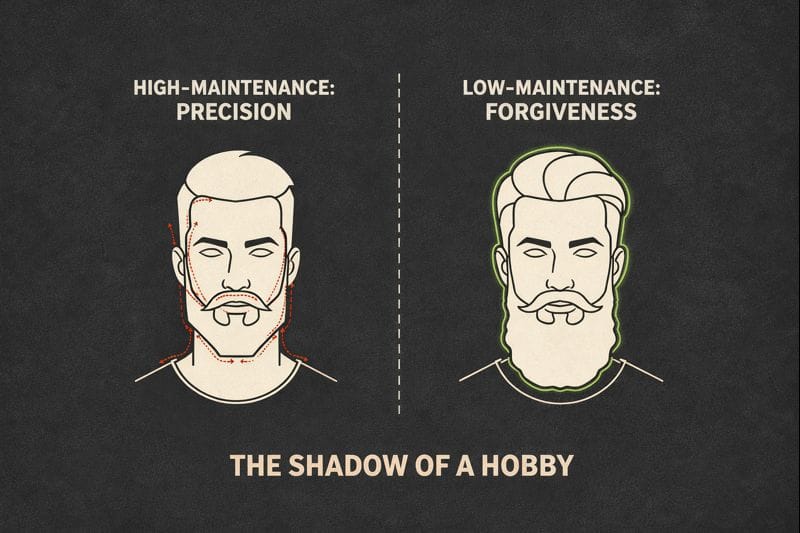
Sharp beards look impressive on day one. Soft, natural beards look settled on day twenty.
How to Choose Without Overthinking It
Ask one honest question:
Can I maintain this beard with a single guard and minimal thought?
If the answer is no, if it needs multiple guards, a straight razor, and a steady hand, it is not low-maintenance. It is a hobby.
Choose the simplest style that survives missed trims and still looks intentional.
The Takeaway
Low-maintenance beard styles work because they accept reality. They accept uneven growth, inconsistent routines, and the fact that you have a life outside the bathroom mirror.
When you stop fighting for control, the beard stops being a chore and starts being an asset.