

Beard problems rarely start in the beard.
Dryness, itch, flaking, redness, tightness, and irritation almost always begin at the skin level. The beard simply makes those problems harder to see and easier to mismanage. When the skin under the beard is unhealthy, the beard above it becomes uncomfortable, brittle, and difficult to live with.
Most men respond to beard discomfort by focusing on the hair. They wash more often, apply heavier products, or trim reactively. That approach treats symptoms while aggravating the cause. Good beard skin care is not about doing more. It is about stabilising the environment beneath the hair so the skin stops demanding attention.
Why Beard Skin Care Is Different From Facial Skin Care
The skin under a beard does not behave like exposed facial skin.
Once hair grows in, it creates a semi-closed environment. Airflow is reduced. Moisture, sweat, dead skin cells, and oil become trapped. This changes how the skin behaves on a daily basis.
On a bare face, sweat evaporates easily and dead skin sheds through normal friction with clothing or towels. Under a beard, these elements remain in contact with the skin for longer. Heat builds more easily. Products linger. Irritation compounds quietly.
This is why advice designed for bare faces often fails once a beard is present. It does not account for the enclosed environment created by facial hair, or the way skin reacts when airflow and evaporation are reduced.
The Biological Foundation of Skin Stability
Every beard hair grows from a follicle embedded in the skin.
To understand why the skin under your beard feels tight or itchy, it helps to understand how the skin protects itself. The surface of the skin is coated in a thin, slightly acidic film made up of natural oils and sweat. This layer helps regulate moisture, limits bacterial overgrowth, and protects the skin from environmental stress.
When harsh soaps are used or washing becomes too frequent, this protective layer is disrupted. Moisture escapes more easily. Sensitivity increases. The skin becomes reactive instead of resilient.
Once that barrier is compromised, irritation under the beard becomes much harder to settle. This is why many skin issues persist despite “good hygiene,” and why understanding how beard growth works alongside skin behaviour matters when diagnosing the problem properly.
The Capillary Wicking Effect
As your beard gains length, a new challenge appears.
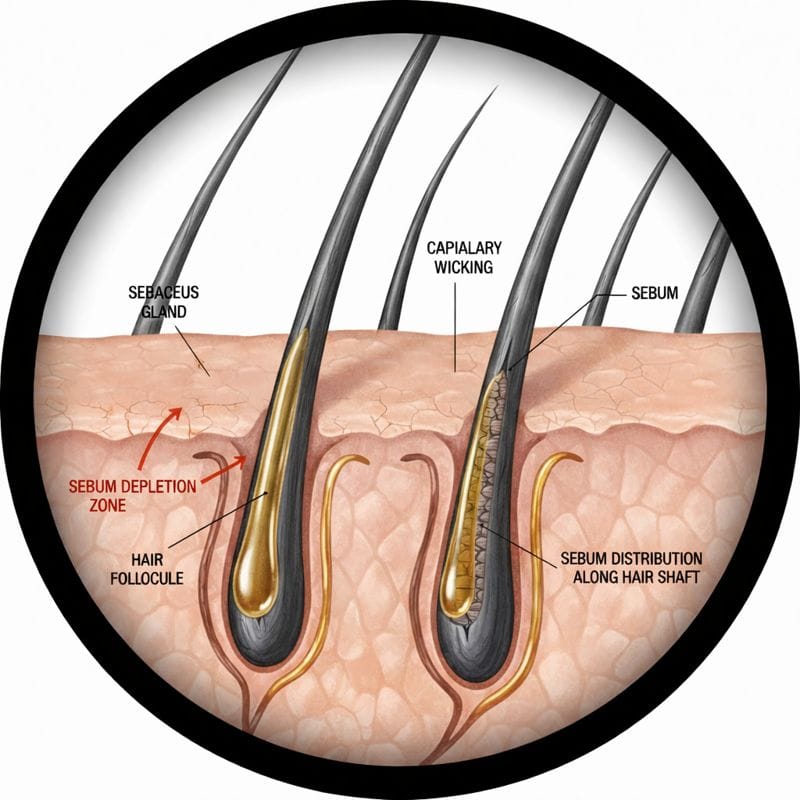
Facial skin produces a limited amount of natural oil to keep itself comfortable. Beard hair, however, is porous. As it grows longer, it acts like a wick, drawing oil away from the skin and distributing it along the hair shaft.
Over time, this leaves the skin beneath the beard under-supported. The hair benefits. The skin does not.
This is why many men who never experienced dry skin suddenly develop flaking or irritation several months into growth. It is not a hygiene issue. It is a distribution problem. Recognising this prevents over-washing and helps explain why beard care must prioritise skin stability before hair appearance.
Why Irritation Builds Quietly Under a Beard
Most beard skin problems do not appear suddenly.
Early dryness feels like mild tightness. Tightness becomes itch. Itch leads to scratching, over-washing, or trimming. Each response removes more oil and increases disruption.
By the time flaking or redness becomes visible, the cycle has already been running for weeks.
This is why beard skin care works best when it is preventative rather than reactive. Healthy skin under a beard should feel quiet. If you are constantly aware of the skin on your face, the environment is already out of balance.
Cleansing Without Stripping the Skin
Over-cleansing is the most common cause of self-inflicted beard skin irritation.
Facial skin is thinner and produces less oil than scalp skin. Treating the face like the scalp leads to oil depletion, increased sensitivity, and persistent dryness.
Most beard skin benefits from minimal cleansing and regular rinsing. Water removes sweat and surface debris without damaging the skin’s protective barrier. Cleansers should be used deliberately when there is genuine buildup, not as a daily default.
Skin that feels tight or “squeaky clean” immediately after washing is not healthy. It is exposed. This is a common trigger for dry skin under the beard and the cascade of problems that follow.
Flaking Is Often Misdiagnosed
Flaking under the beard is frequently mismanaged because it is misunderstood.
Dry skin tends to produce small, white flakes and is often caused by over-washing, cold air, or stripped oil. In contrast, seborrhoeic dermatitis is linked to a yeast that naturally lives on the skin and thrives in warm, enclosed environments. Its flakes are often larger, slightly yellow, and accompanied by redness.
This is a biological shift in the skin’s flora, not a layer of ‘dirt’ that can be scrubbed away. Treating it with aggression only provides more inflammation for the yeast to feed on.

Both conditions worsen with aggressive scrubbing. Both improve when the skin barrier is respected. Understanding beard dandruff as a biological condition rather than a cleanliness failure prevents repeated mistakes.
Beard Itch Is a Signal, Not a Failure
Beard itch is one of the main reasons men abandon growth.
It is rarely caused by the hair itself. Early on, short hairs curl back toward the skin and create mechanical irritation. Later, longer hair pulls oil away from the skin, increasing dryness.
Scratching provides short-term relief but creates micro-damage that prolongs irritation. Trimming reduces discomfort briefly but resets progress.
Reducing itch requires calming the skin environment, not fighting the beard. This is why beard itch is best addressed by stabilising the skin rather than increasing grooming intensity.
Physical Friction and Mechanical Stress
The skin under the beard is exposed to constant friction.
Brushing, combing, and habitual touching all apply mechanical stress. When this stress becomes aggressive or repetitive, it inflames the skin and stresses the follicles.
Gentle guidance helps hair sit naturally. Force creates resistance. Reducing unnecessary friction matters more than perfect technique, particularly as length increases.
Consistency and the Skin Repair Cycle
Skin repairs itself slowly.
Barrier recovery happens over weeks, not days. One of the most common beard skin care mistakes is changing approach every time irritation appears. Each reset interrupts the repair process.
A restrained, consistent approach almost always outperforms aggressive intervention. This is why a simple beard care routine often succeeds where complex strategies fail.
The IronMane Position
Beard skin care is about restraint.
Most irritation is self-inflicted through over-management. The goal is not to perfect the skin with layered products or constant adjustments, but to leave it stable enough that it stops demanding attention.
When the skin under your beard is supported properly, the beard above it becomes easier to live with. Comfort returns. Interference decreases. The beard settles on its own terms.
If skin care feels like a constant project, something is being disrupted unnecessarily. Healthy skin is quiet. When it is allowed to stabilise, the beard becomes a natural extension of your face rather than a problem to solve.