


At some point, every beard reaches a stage where it stops growing longer. For some men, that happens at a couple of inches. For others, it might extend much further before levelling off. Either way, there’s a ceiling, and that ceiling isn’t random. It’s called terminal beard length.
The term sounds technical, but the idea is straightforward. Terminal length refers to the maximum length an individual beard hair can grow before it naturally sheds and resets. It usually isn’t the result of poor grooming, and it rarely means something’s wrong. It’s the outcome of a biological timer built into each follicle, operating quietly beneath the surface.
To understand why this happens, it helps to step back and look at how beard growth works in the first place. Hair doesn’t grow continuously. It grows in phases, and those phases ultimately determine how long any beard can become.
The Growth Cycle In Plain English
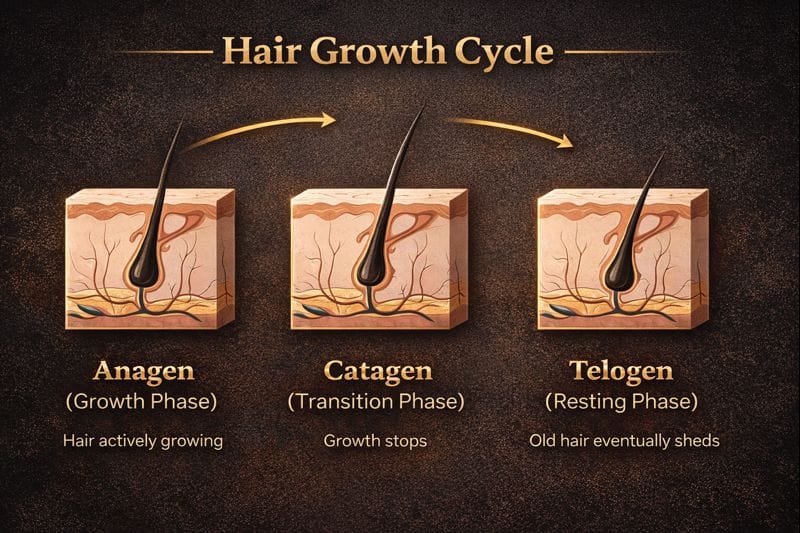
Every beard hair moves through a repeating cycle. The most important stage for length is the anagen phase, which is the active growth period. While a hair remains in anagen, cells at the base of the follicle divide, push upward, and lengthen the shaft little by little. This continues until the follicle shifts into a short transitional stage and eventually a resting phase, where the hair sheds and the cycle begins again.
The critical variable isn’t effort or product choice. It’s how long the anagen phase lasts.
On the scalp, the anagen phase can last several years. That’s why head hair can grow very long if left untouched. On the beard, the anagen phase is typically shorter. For many men, it may last several months to a couple of years, although the exact duration varies significantly from person to person.
If your follicles remain in anagen for a shorter period, your beard reaches its maximum visible length sooner. Once that growth window closes, the hair sheds, and a new one begins growing in its place. From the outside, it can look like growth has stalled. In reality, you’ve simply reached the natural endpoint of that cycle. That endpoint is your terminal beard length.

Why Some Beards Grow Much Longer Than Others
Two men can follow identical routines, use the same products, and maintain similar skin health, yet end up with very different maximum lengths. The explanation usually lies in genetics and how each person’s follicles respond to androgens, particularly testosterone and dihydrotestosterone (DHT), the hormone largely responsible for triggering facial hair growth in the first place.
Facial hair growth is strongly androgen-dependent. Hormonal sensitivity influences density, thickness, and growth rate. However, terminal length depends heavily on the duration of the growth phase itself. One person may have dense, thick coverage but a relatively short active phase. Another may have moderate density yet a longer anagen window, allowing individual hairs to extend further before shedding.
If you want to explore that side of growth in more detail, the guide on Age, Genetics and Beard Growth explains how inherited factors shape what’s realistically possible. Concerns about uneven development are often separate from terminal length. In those cases, Why Is My Beard Patchy? may be the more relevant place to look.
The key point is that length potential isn’t purely about discipline. It’s about duration.
Terminal Length Versus Breakage
It’s important not to confuse terminal length with breakage, because they can appear similar in the mirror.
True terminal length occurs when a hair completes its natural growth phase and sheds from the follicle. Breakage, by contrast, is mechanical damage. If beard hairs become dry, brittle, or repeatedly stressed through friction, harsh brushing, or excessive heat, they can snap before reaching their biological maximum.
When that happens, the beard appears stuck at a certain length, but the limitation is structural rather than programmed. Improving conditioning, maintaining skin health, and reducing chronic irritation can help hair reach its natural potential. What these steps can’t do is extend the anagen phase itself. They allow you to realise your ceiling, not raise it. Understanding that difference keeps you from chasing miracle fixes when the real issue is care.
| Feature | Terminal Beard Length | Breakage |
|---|---|---|
| Cause | Natural end of growth phase | Mechanical damage |
| Occurs at follicle level? | Yes | No |
| Can grooming fix it? | No | Often yes |
| Changes anagen duration? | No | No |
| Preventable? | No | Usually |
Does Trimming Change Your Terminal Length?
Cutting the visible hair shaft doesn’t alter what’s happening inside the follicle. Trimming reshapes the beard and can improve balance and fullness, but it doesn’t extend the growth phase or increase maximum length. If a beard looks healthier after shaping, that improvement comes from structure rather than biology. The follicle continues to follow its internal clock regardless of how often the ends are tidied.
Once growth begins to plateau, refinement usually becomes more valuable than force. Learning how to trim and groom your beard properly often produces a stronger overall result than continuing to chase length. Exploring proportion and face shape can also help you work with your natural limits instead of against them.
Recognising When You’ve Reached Your Ceiling
You’re likely near your terminal beard length if your beard growth has plateaued for several months after steady earlier growth, density remains consistent, shedding appears normal, and there are no obvious signs of snapping or thinning at the ends. At that stage, pushing harder rarely changes the outcome.
Instead, the focus shifts. Length becomes less important than proportion. Structure starts to matter more than extension. A beard that sits confidently at its natural maximum, shaped and maintained properly, almost always looks stronger than one chasing extra centimetres beyond what the follicle can realistically sustain.
Terminal length isn’t a limitation in the negative sense. It’s simply the point where growth transitions into maintenance.
FAQs


