You will see hair early. Seeing hair is not the same as having a beard. Density, shape, and coverage develop on different timelines. Understanding those timelines helps you avoid early frustration and poor decisions.
This guide explains what actually happens, when it happens, and when it makes sense to reassess.
What “Growing a Beard” Really Means
Before talking about time, you need clarity on the goal. A beard is not just facial hair. It is a structural outcome.
A true beard requires:
Hair covering the cheeks, jawline, chin, and moustache.
Enough length for separate areas to visually connect.
Minimal see-through gaps at a normal conversational distance.
A beard is a result of connection, not a measurement in centimetres. Many men believe they have “failed” at four weeks because they are looking for a finished structure when they only have a collection of isolated hairs.
How Fast Does Beard Hair Grow?
On average, facial hair grows at a rate of roughly half an inch (1.25 cm) per month.
That figure is a biological baseline. It hides a more important truth. Your beard does not grow evenly.
Some follicles wake up sooner than others.
Cheeks often lag behind the chin and moustache.
Density fills in gradually through follicle maturation.
Early growth often looks worse before it looks better. This is not a sign of poor genetics. It is a sign of an unsynchronised system. You are not just waiting for hair to grow; you are waiting for the system to align.
How Long Does It Take to Grow a Beard at Each Stage?
These timelines are averages. They describe the biological progression most men experience. They are not guarantees.
While these benchmarks provide a general overview, you can find a more detailed, week-by-week breakdown of the physical and psychological shifts in our guide to Beard Growth Stages.
Around 1 Month
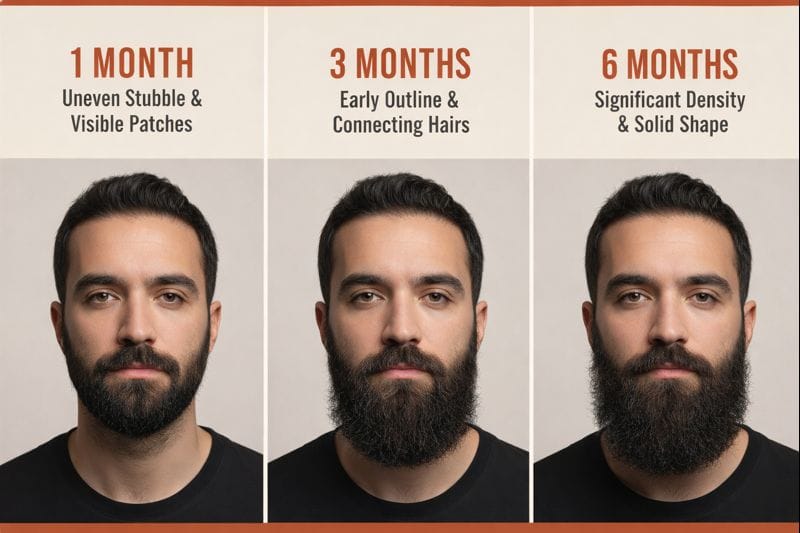
Stubble is clearly visible. Coverage looks uneven. Patchy areas are common. At this stage, many men decide their beard “isn’t happening”. That judgment is premature. One month tells you very little about your final potential. It is a snapshot of an unfinished process.
Around 3 Months
The beard begins to show a recognisable outline. Patchiness often appears less obvious as slower hairs finally catch up. You now have enough growth to evaluate direction, but not the final outcome. Three months is the earliest sensible checkpoint. Anything earlier is guesswork.
Around 6 Months
Density improves significantly as vellus hairs transition to terminal hairs. Shape becomes easier to control. Remaining weak areas are easier to judge honestly.
For most men, six months reveals the limits and strengths of their natural growth pattern. Refinement continues beyond this point, but surprises are rare.
Beard growth develops unevenly over time, with visible changes becoming clearer as length increases.
Why Timelines Vary Between Men
If your beard is slower or thinner than someone else’s, it is not a failure. It is biology.
The Scalp Paradox
This progression often surprises men because it contradicts how we think about hair on the head. Scalp hair tends to thin with age. Beard hair often does the opposite. Beard growth commonly thickens, darkens, and connects well into your thirties. This is why late starters often end up with stronger beards than early growers.
Biological Factors That Matter
Genetics: Follicle placement and your density ceiling.
Androgen sensitivity: How your follicles respond to testosterone and DHT over time.
Consistency: Uninterrupted growth allows cycles to complete.
These factors define your ceiling. They influence timing and density, but they do not respond to shortcuts. No supplement or hack overrides them. Anyone promising one is selling hope, not results.
When to Reassess Your Beard Growth
A realistic reassessment window is between three and four months of uninterrupted growth. At that point, you have enough information to apply judgment instead of emotion.
You can then decide to:
Continue growing if coverage is present, but density is still maturing.
Adjust the style if certain areas are strong and others are biologically limited.
Maintain a shorter length if the current density works better as heavy stubble.
Reassessing is not quitting. It is making an informed decision based on the evidence on your face.
The IronMane Constraint
Growing a beard is slow because it is meant to be. Hair follicles operate on biological cycles, not motivation.
Comparing a week-four beard to a year-two photo online.
Visible hair arrives early. A good beard takes time. Patience is not passive. It is an active decision to let the process play out before you interfere.
If you want to grow a beard, the question is not just how long it takes to grow. The question is whether you are willing to give it long enough to show you what is possible.
New Here?
Start Your Beard Journey
If you are still figuring out growth, care, or what products actually matter, begin with the structured 90 day roadmap.
I’m Mike, a co founder of IronMane Grooming. I started the site after seeing too much confusing advice, unrealistic beard growth claims, and routines that did not fit real life. Most men do not need complicated systems, they need clear expectations, simple habits, and advice they can trust. IronMane Grooming exists to be a long term, practical resource for honest beard care, built with Dave to make that information easy to find and use.