


Understanding beard products is one of the most confusing parts of beard care.
When discomfort appears, most men reach for something new. Itch leads to oil. Dryness leads to balm. Stiffness leads to butter. When the beard still feels wrong, the routine expands. More products, more steps, more effort.
Most of the time, the beard does not improve.
This is not because beard products are useless. It is because they are misunderstood. Beard products do not create growth, fix genetics, or replace time. Their role is narrower and quieter. Used well, they reduce friction and support the skin and hair while growth takes place. Used poorly, they interfere with the systems they are meant to support.
This guide explains what beard products actually do, when they matter, and why doing less usually produces better results.
The Core Mistake in Understanding Beard Products
The most common mistake in understanding beard products is believing they drive results.
They do not.
Beard growth is governed by biology. Hair grows according to follicle cycles, genetics, age, and hormonal signalling. Products cannot accelerate that process. What they can influence is comfort, skin stability, and how the beard behaves day-to-day.
When beard products are treated as fixes, they are usually applied too early, too often, or in the wrong combination. This is how irritation, greasiness, clogged pores, and inconsistent results appear.
Products are not drivers. They are environmental tools.
Beard Products Exist to Reduce Friction
Good beard care removes obstacles.
Dry skin, irritation, breakage, stiffness, and tangling all create friction. That friction leads to scratching, trimming, reshaping, and routine hopping. Each of those actions interrupts progress.
A beard product is useful if it allows you to leave the beard alone.
If it encourages more handling, more washing, or more correction, it is working against you.
This principle matters more than any product category.
Skin Comes First in Beard Product Use
Every beard product interacts with the skin before it affects the hair.
This is where many routines fail. Products are chosen for how the beard looks or smells rather than how the skin responds underneath.
The skin under the beard is thinner and more sensitive than the scalp. It exists in a semi-closed environment where oil, moisture, sweat, and dead skin accumulate. Products linger longer. Mistakes compound faster.
When skin health declines, beard hair becomes brittle, wiry, and difficult to manage. No product can compensate for an irritated base. Understanding beard products starts with understanding skin behaviour.
Why Fragrance Often Causes Problems
Many premium beard products rely heavily on fragrance.
Fragrance is also one of the most common causes of irritation under the beard. Redness, itching, and tightness are often misdiagnosed as dryness when they are actually low-grade contact reactions.
Because the beard traps products against the skin for long periods, even mild irritants can build into persistent discomfort. Removing fragrance often resolves issues faster than adding more moisture.
Beard Oil: What It Actually Does
Beard oil is the most misunderstood beard product.
It is often marketed as a growth aid or shine enhancer. Neither description is accurate. Beard oil is a skin-support product.
As beard hair grows longer, it draws natural oil away from the skin and distributes it along the hair shaft. This leaves the skin under-supported and prone to dryness and itch. Beard oil helps replace what the skin can no longer retain at the surface.
Applied sparingly and worked into the skin first, oil reduces tightness and irritation. Used too early or too heavily, it creates a greasy surface that traps heat and debris and encourages over-washing.
Why Oil Type Matters More Than Amount
Not all beard oils behave the same way.
Lightweight oils with molecular structures similar to human sebum absorb more readily. Heavier oils tend to sit on the surface. That can be useful for hair protection, but problematic at the skin level, where buildup and clogged pores become more likely.
If beard oil feels greasy or makes the skin itch, the issue is often formulation rather than quantity.


Beard Balm and Butter Support Hair, Not Skin
Where beard oil supports the skin, balm and butter support the hair.
These products coat the hair shaft, reducing moisture loss and adding weight. This improves manageability once the beard reaches a length where hair begins to bend, tangle, or resist gravity.
They are rarely necessary in short beards. Using them too early leads to buildup at the skin and dull, heavy hair. Layering oil, balm, and butter together in the hope of maximum nourishment usually suffocates the system rather than improving it.
One product, chosen for the stage you are in, is almost always enough.
Cleansers and the “Squeaky Clean” Problem
Beard cleansers exist to remove buildup, not to create daily freshness.
Most beards do not need daily washing with product. Water rinsing is often sufficient to remove sweat and surface debris. Frequent cleansing strips natural oil and destabilises the skin barrier.
Using standard scalp shampoo on the beard is a common mistake. These products are designed to remove heavy scalp oils and are too aggressive for facial skin.
A beard that feels squeaky clean is not healthy. It is exposed. This state of exposure is known as a compromised skin barrier, which significantly increases the rate of moisture loss from the skin.
Technical Note: Clinical studies on the impact of surfactants on the skin barrier demonstrate that aggressive cleansing can lead to long-term disruption of the stratum corneum (the outermost layer of skin), even if the irritation isn’t immediately visible.
When Water Quality Affects Beard Products
In hard water areas, minerals in tap water can bind to soaps and oils, creating residue that sticks to hair and skin.
This buildup can make the beard feel dry and wiry, even when products are used correctly. Adding more product often makes the problem worse. Reducing washing frequency or changing cleansing approach is usually more effective.
Conditioners and Softening Products
Conditioners smooth the hair cuticle and reduce friction between strands.
They become more useful as beards grow longer and mechanical damage becomes more likely. They are not a solution for skin discomfort. Conditioning an itchy beard treats the symptom while leaving the cause untouched.
Hair support should never be confused with skin repair.
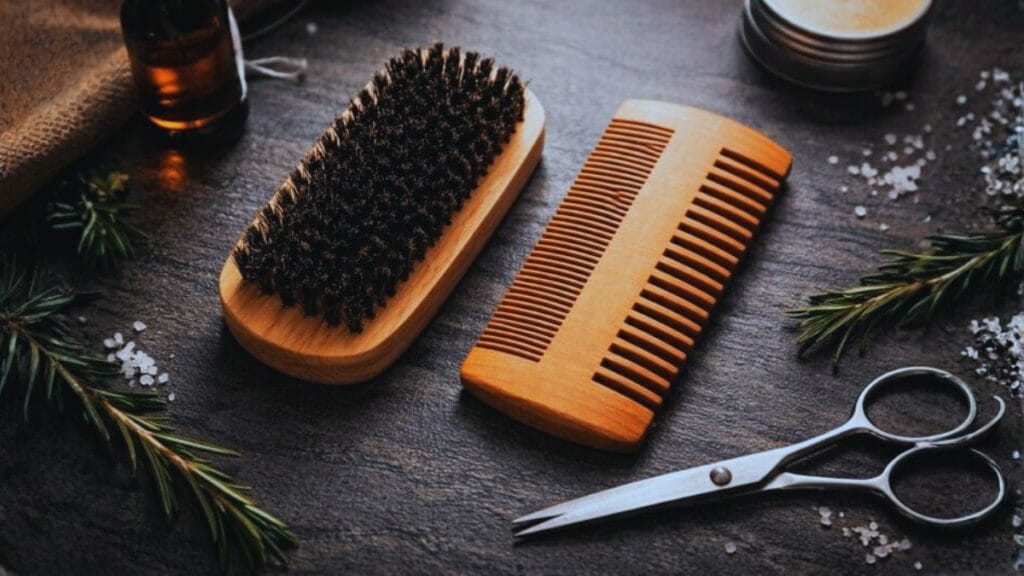
Beard Tools and Product Interaction
Brushing and combing do not stimulate growth.
Their role is mechanical. They help distribute oil, remove loose debris, and guide hair into a natural shape. Used gently, they reduce friction. Used aggressively, they create it.
Tools should make beard products work better, not compensate for overuse.

Product Timing Matters More Than Product Choice
Many beard problems come from using the right product at the wrong time.
Early in growth, the skin is often self-sufficient. Heavy intervention creates problems that did not exist. As length increases, oil distribution becomes less efficient, and tangling becomes more likely. This is when targeted support becomes useful.
Understanding beard products includes knowing when not to introduce them.
The Illusion of Premium Beard Products
The beard does not recognise branding.
It responds to chemistry, frequency, and handling. Many expensive products rely on packaging and fragrance rather than functional improvement. A stable, simple routine with basic formulations will outperform a luxury routine that changes every few weeks.
Consistency beats novelty.
The IronMane Position on Understanding Beard Products
Understanding beard products is not about knowing what to buy.
Beard products are tools, not solutions. They do not replace patience, they do not override biology, they do not correct genetics. Their job is to reduce friction so growth can continue without interruption.
Most beards do not fail because the wrong product was chosen. They fail because too many products were introduced too early, used too often, and applied with the wrong expectations.
If a product encourages you to leave your beard alone, it is doing its job.
If it encourages more fixing, more washing, or more trimming, it is working against you.
Understanding beard products means knowing when to stop.


