

Most beard mistakes start at the neckline.
Too high, and the beard looks thin and artificial. Too low and it looks sloppy, heavy, and unfinished. Many men trim their beard perfectly everywhere else, then undo weeks of growth with one panicked line under the chin.
The neckline is not about style. It is about architecture. You don’t notice it when it’s right, but everything starts to fall apart when it isn’t. Get it right, and the beard looks intentional. Get it wrong and the whole thing starts to look out of place.
Why the Neckline Matters More Than You Think
The neckline is the foundation of your beard. It controls perceived density, jaw definition, and how clean the beard looks between trims.
A good neckline does three practical things:
- Creates a clear transition between beard and neck
- Supports the shape of the jaw rather than fighting it
- Makes the beard look fuller without needing extra length
A bad neckline does the opposite. It exposes weak growth, exaggerates softness under the chin, and makes even a well-groomed beard look accidental.
The Biggest Neckline Mistake
The most common error is trimming the line too high. Many men draw a sharp line right along the jawbone because it feels clean and controlled.
In reality, this strips away the beard’s foundation. The jaw looks harsher, the beard looks smaller, and the whole thing starts to resemble stubble glued to the face rather than grown from it.
Beards need weight under the chin. That weight is what gives them presence.
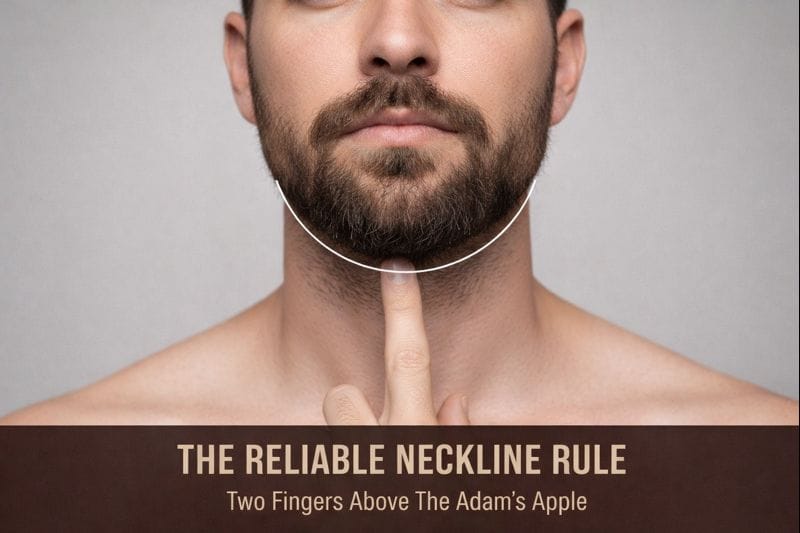
The Reliable Rule: Two Fingers and the Earlobe
Forget complicated internet diagrams. Anatomy is the guide that matters.
The Adam’s apple anchor: Place two fingers horizontally above your Adam’s apple. The top of your second finger marks the lowest point of your neckline.
The neutral head position: This is critical. You may need to tilt your head up briefly to find the spot. Before you make the cut, return your head to the centre.
If you trim while the skin is stretched, the line will snap upward. When you look forward again, it will sit too high. Only trust the line when you are looking yourself in the eye.
The earlobe connection: From that centre point above the Adam’s apple, curve the line gently upward toward the corner of the jaw, aimed just behind each earlobe.
Do not try to draw this curve in one stroke. Work from the centre to the left, then from the centre to the right. Symmetry is easier to manage when you are not fighting the natural pivot of your wrist.
This rule works because it respects your bone structure. It leaves enough beard under the chin to support the face while keeping the neck clean.
Shape the Line. Do Not Draw It Flat.
Your head is not flat. Your beard should not be either.
The neckline should follow a shallow U-shape from ear to ear, dipping slightly at the centre. This curve mirrors the natural shape of the jaw and avoids the boxed-in look that straight lines create.
If you can, use a hand mirror to check your profile. A line that looks perfect from the front can look uneven from the side. Perspective is one of the most reliable tools you have.
IronMane Insight: If you have to choose between slightly too low and slightly too high, err lower. You can always refine a line upward, but you can’t put hair back once it’s in the sink.
Adjusting for Beard Length
The correct neckline is not fixed. It shifts as the beard gains length and weight.
Short Beards
Keep the neckline clean but conservative. At shorter lengths, the beard has less mass to hide mistakes. Trimming too high will be immediately obvious.
Medium to Long Beards
As the length increases, the neckline can sit lower. A slightly lower neckline helps the beard flow rather than sitting on top of the face like a helmet.
At this stage, structure matters more than precision.
Blending Matters More Than the Line
The neckline should not look like it was drawn with a marker.
After setting the line, lightly soften the transition. Use a longer guard than the one you used to set the line itself and work upward. This creates a subtle fade that prevents the beard from looking stamped onto the face.
Sharp lines belong on cheeks. Necklines benefit from restraint.
The Danger of Trim Fatigue
Most beards need less intervention than you think.
Do not chase the neckline daily. Constant touch-ups lead to gradual creep upward. You fix a tiny unevenness on Monday, another on Tuesday, and by Friday, the beard has migrated halfway up the jaw.
For most beards:
- Light cleanup every few days is enough
- A full neckline reset every one to two weeks keeps things stable
Let the beard settle between trims. Put the trimmer down and give the hair time to reveal its natural structure.
The Neckline Mindset
A good beard neckline should be almost invisible. If people notice the line itself, it is probably too sharp or too high.
The goal is for the beard to look like it belongs on your face, not like it was carved into place.
Support the jaw. Preserve the foundation.
That is how a beard looks, grown, not drawn.