


Most beard mistakes are not caused by bad growth or poor products. They are caused by using the wrong tool at the wrong time.
Beard trimmers and scissors do very different jobs, yet they are often treated as interchangeable. They are not. Each tool interacts with beard hair in a specific way, and choosing incorrectly can set back growth, worsen patchiness, or create maintenance problems that did not exist before.
What Matters More Than the Tool
Before comparing tools, it is important to understand what trimming actually does. Every cut changes three things at once:
- Hair length
- Hair tip shape
- Visual density
Most trimming mistakes happen when men think they are changing only length, while quietly altering all three.
A tool that removes hair evenly does not behave the same as one that removes hair selectively. The right tool depends less on preference and more on your beard’s current stage and long-term direction.
How Beard Trimmers Work: Mechanical Shearing
Beard trimmers are mechanical cutting tools designed to reduce the length quickly. They use two blades moving rapidly against each other to shear hair.
The Physics of the Mechanical Cut
Unlike a blade that slices, a trimmer relies on a crushing shear action.
The heat factor. Motorised blades create friction. At a microscopic level, this friction can slightly stress or roughen the hair cuticle at the point of contact.
The tension trap. Trimmers with guards rely on tension. The plastic teeth pull the hair straight before cutting it. Because beard hair curls and grows in different directions, it often springs back unevenly once that tension is released. This is why a beard can look level immediately after trimming, but uneven once it relaxes.
Where Trimmers Excel
Trimmers are most effective when structure matters more than detail.
They work best for short beards and stubble, resetting overall length, and maintaining consistent bulk. During early growth, trimmers provide speed and predictability, reducing the risk of accidentally over-cutting one area while leaving others untouched.
Uniform length is the trimmer’s strength.
Where Trimmers Cause Problems
The mechanical nature of trimmers makes them blind tools.
They remove all hairs that reach the cutting height, including those that contribute to essential coverage. On a developing beard, trimmers often remove connector hairs that bridge thinner areas. The result is a beard that looks neater but less dense.
This is why many men feel stuck at the same length. They are trimming away progress without realising it.
How Beard Scissors Work: The Cold Slice
Beard scissors are manual precision tools. Unlike trimmers, they create a cold cut, producing a clean slice through the hair shaft without heat or mechanical friction.
Where Scissors Excel
Scissors are most effective when refinement matters more than speed.
They allow you to remove individual flyaway hairs without disturbing surrounding growth that provides structure and density.
Because scissors cut hair in its natural resting position, the shape you see in the mirror is the shape that remains throughout the day.
Selective cutting preserves bulk.
Where Scissors Fall Short
Scissors are inefficient for major length resets.
They require patience and visual judgement. For very short beards or stubble, scissors are impractical for achieving a uniform look and increase the risk of uneven results.
They are a refinement tool, not a shortcut.

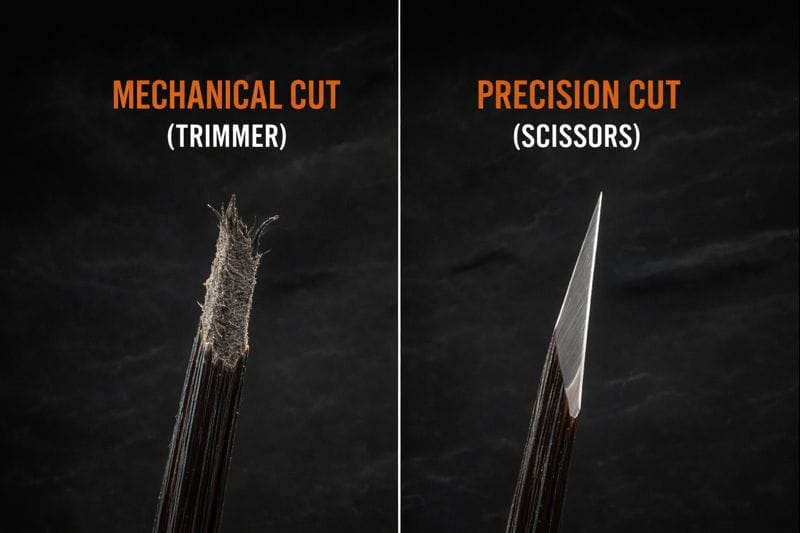
Beard Trimmer vs Scissors: The Practical Comparison
Speed vs Control
Trimmers are fast. Scissors are controlled.
If your goal is to reduce length quickly, a trimmer is appropriate. If your goal is to improve shape without losing length, scissors are the safer option.
Speed removes thinking. Control requires it.
IronMane Pro Tip: When using scissors, always trim with the hair dry; hair stretches when wet, and a ‘perfect’ wet trim will almost always shrink into a jagged shape once the hair dries.
Uniformity vs Density
Trimmers create uniform length, which can look tidy but often exposes thin areas. Scissors protect variation. Variation allows longer hairs to overlap weaker zones, increasing the appearance of fullness.
For developing beards, density usually matters more than uniformity.
Skin Impact
Trimmers cut hair close and evenly, which re-sharpens tips. For men prone to beard itch or sensitivity, frequent trimmer use can prolong irritation.
Scissors leave existing hair tips intact and avoid repeated contact with the skin.
The Most Common Tool Mistakes
Trimming Too Early
Many men trim as soon as the beard feels untidy.
At that stage, length is doing important work. It connects areas and softens contrast. Trimming early with a mechanical tool removes that progress.
Messy does not mean wrong. It often means unfinished.
Chasing Symmetry
Perfect symmetry is rare in natural beard growth.
Trimmers amplify asymmetry by cutting both sides equally, even when growth is uneven. Scissors allow you to compensate by trimming less where growth is weaker.
Beards look better balanced than mirrored.
Guard Reliance
Trusting a trimmer guard to be foolproof is a mistake.
Because of the tension trap, guards often create gaps once the hair settles. When using a trimmer, always cut slightly longer than your target length and reassess after the beard relaxes.
How This Fits Into Beard Product Use
Trimming tools do not work in isolation.
Trimmers interact with washing, oiling, and brushing habits. Scissors rely more on patience and visual judgement. Understanding when to trim is part of understanding how beard products and tools work together, not separately.
That wider framework is covered in the Understanding Beard Products guide.
The IronMane Position
Beard trimmers remove length. Scissors manage shape.
Most beard problems come from confusing those two actions.
If your beard is short, uneven, or being reset often, a trimmer makes sense. If your beard is growing, filling in, and becoming denser, scissors protect progress.
Choose the tool that supports where your beard is going, not where it happens to be today.


