


Choosing a beard style often starts with a photo—a sharp jawline here, a thick, full beard there. The problem is that most of those examples ignore the face underneath.
A beard style does not exist in a vacuum. It works in partnership with bone structure, proportions, and growth patterns. When a beard looks “wrong,” it is usually because it is fighting the face shape rather than supporting it.
A good beard style does not make a statement. It quietly fixes proportion.
How to Identify Your Face Shape
You do not need a tape measure or a diagram. Use the Soap Trace method: Stand in front of a mirror, keep your head level and still, and use a bar of soap (or a dry-erase marker) to trace the outline of your face directly onto the glass.
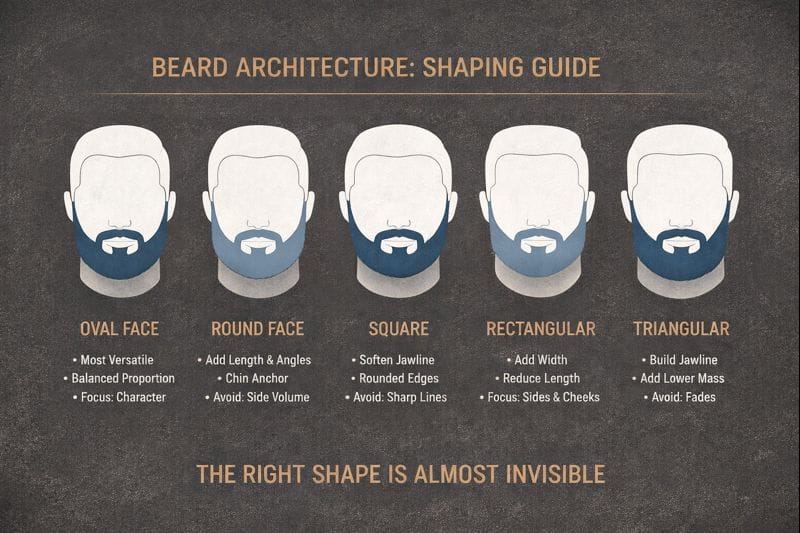
Step back and look at the silhouette. You will usually see one of five broad structures.
Oval: The Neutral Canvas
An oval face is the most forgiving. The proportions are already balanced, which means the beard should add character, not correction.
- The Goal: Maintain natural symmetry.
- The Play: Most styles work, but a Short Boxed Beard or a tapered full beard keeps the look controlled and professional.
- The Risk: Adding excessive length at the chin, which “stretches” the face vertically.
IronMane Insight: If you have an oval face, restraint matters more than ambition. Structure beats size.
Round: Creating the Illusion of an Edge
A round face has soft angles and fuller cheeks. The beard needs to act as a visual anchor that draws the eye downward and introduces corners where none exist.
- The Goal: Add length and create artificial angles.
- The Play: Keep the sides tight and concentrate length at the chin. Angular cheek lines help break up roundness.
- The Risk: Full, bushy sides that widen the face and create a “neck-brace” effect.
IronMane Insight: Round faces do not need more volume. They need direction.
Square: Softening the Stronghold
A square face already has presence—strong jaw, wide cheekbones, clear angles. The beard’s job is refinement, not reinforcement.
- The Goal: Soften the blocky outline.
- The Play: Rounded edges, natural cheek lines, and medium length with softened corners.
- The Risk: Sharp, 90-degree lines that make the beard look artificial and over-engineered.
IronMane Insight: If your jaw is already doing the work, your beard should calm it, not compete with it.
Rectangular or Long: Controlling the Vertical
A long face is noticeably taller than it is wide. The beard should “shorten” the appearance of the face rather than extend it further.
- The Goal: Add width and reduce vertical pull.
- The Play: Fuller sides and cheeks with a shorter, rounded bottom.
- The Risk: Pointed goatees or long, narrow beards that exaggerate length.
IronMane Insight: Length is not always progress. For long faces, restraint creates balance.
Triangular or Heart: Building the Foundation
This shape features a wider forehead and cheekbones with a narrower jaw. Here, the beard provides the structural weight that the face doesn’t naturally have.
- The Goal: Add mass where bone structure is missing.
- The Play: Fuller, denser growth at the jaw and chin with a rounded finish.
- The Risk: Faded sides or minimal styles that highlight a narrow lower face.
IronMane Insight: For triangular faces, a beard is load-bearing, not decorative.

The Theory vs. Reality Check
Face shape is the guide; growth pattern is the boss.
Patchiness, density, and growth direction can override theory. A technically ideal beard style that fights your natural growth will always look worse than a slightly imperfect style that works with it. Understanding how styles are defined—knowing the mechanics of a goatee versus a boxed beard—allows you to adapt rather than force it.
Common Mistakes to Avoid
- The Photo Trap: Choosing a beard based on a model with a completely different jawline.
- Over-Shaping: Using sharp cheek lines to add “structure” to an already angular face (it looks like a Lego beard).
- Growth Fear: Avoiding the trimmer because you are “growing it out,” even when the current shape is throwing your proportions off.
How to Choose Without Overthinking It
Ask two mechanical questions:
- Do I need more length or more width?
- Does my jaw need more definition or more softening?
Then choose the simplest beard style that solves those problems.
The 3-Day Rule: Once you pick a direction and trim your new shape, live with it for three days before you reach for the trimmer again. Your eyes need time to adjust to your new proportions before you decide if it was a mistake.
The Takeaway
Trends fade; proportion lasts.
A good beard style should almost disappear in the sense that it makes your face look “settled.” When the beard and bone structure stop fighting each other, grooming stops being a chore and starts feeling deliberate.


