

Most beard products look identical on the shelf. Dark glass. Earthy names. Bold claims about “nourishment,” “strength,” or “growth.”
The front of the bottle is for the marketing department. The back of the bottle, the ingredient list, is for you.
If you can read that list properly, you stop relying on branding and start making decisions based on how hair and skin actually function. This is not about finding “perfect” products. It is about building the skill to see through the noise and understand how beard products actually work.
Why the Ingredient List Matters More Than the Label
Marketing language is largely unregulated. You can call almost anything “natural” or “strengthening” without a lawyer stepping in. Ingredient lists are different.
Manufacturers are legally required to list what is actually inside, in descending order of concentration. The first three to five ingredients do most of the heavy lifting. The rest of the list either supports the formula or exists in trace amounts for label appeal.
Once you understand this structure, you can tell whether a product is designed to condition hair or whether it is little more than cheap filler with an expensive scent.
Learn the Base First: Identifying the Tool
Every product has a foundation. Identifying the base tells you exactly what that tool is designed to do, regardless of what the name on the bottle says.
1. Oil-Based (The Conditioners)
Common bases include jojoba, argan, sweet almond, or grapeseed oil.
The reality: These oils are designed to mimic sebum and reduce brittleness. They help hair bend instead of snap.
Oils do not hydrate hair. They reduce moisture loss.
The IronMane take: If oils dominate the top of the list, it is a conditioner. Period. If you are looking for hold or styling power and you see an oil-first list, you have picked up the wrong bottle.
2. Butter-Based (The Heavy Lifters)
Shea, mango, or cocoa butter appear near the top of the list.
The reality: Butters add weight and form an occlusive layer that slows moisture loss. They sit heavier on both hair and skin.
The IronMane take: Butters are not “premium” versions of oils. They are simply heavier tools for coarser, drier beards. If your beard is thin, a butter-heavy list will usually just make you look greasy.
3. Wax-Based (The Sculptors)
Beeswax or candelilla wax signals structure.
The reality: Wax provides the tack needed to shape the beard and pin down flyaways.
The IronMane take: High wax content is always a trade-off. You gain control, but if that wax is not balanced with high-quality oils, your beard will often feel stiff and parched by midday.
4. Water-Based (The Cleaners)
If “Aqua” is the first ingredient, you are looking at a wash or a leave-in product.
The reality: These formulas rely on surfactants to clean or humectants to create immediate softness and slip.
Water-based products work fast, but their effects are temporary.
The “Dusting” Ingredients
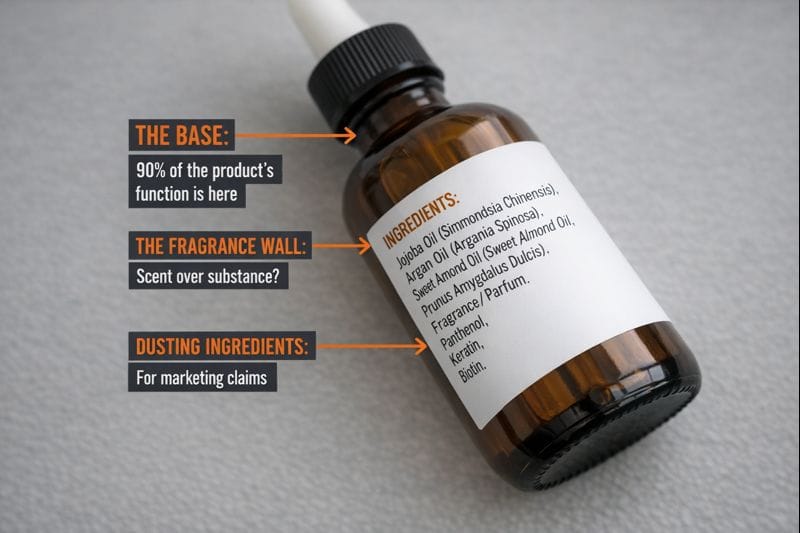
Ingredients like biotin, caffeine, charcoal, keratin, or exotic plant extracts almost always appear at the very end of the list.
In the industry, these are often called dusting ingredients. They are used at such low concentrations that they contribute virtually nothing to performance. Their real role is to justify a headline on the front of the bottle.
Do not judge a product by its headline. Judge it by its base.
Silicones: The Makeup of the Beard World
If you see ingredients ending in -cone or -siloxane, you are looking at silicones.
Silicones are not toxic. They are cosmetic. They coat the hair to create artificial slip and shine rather than improving the structure of the hair itself.
Think of them as makeup for your beard. If your beard feels incredible for two hours but feels like straw the next morning, silicones are often masking the fact that the underlying hair is dehydrated.
Preservatives: Not the Enemy
A common marketing tactic is to boast about being “preservative-free,” especially in water-based products.
This is a warning sign, not a benefit. A water-based product without adequate preservation, such as phenoxyethanol or potassium sorbate, is an unstable breeding ground for mould and bacteria.
A stable, properly preserved product is a professional product.
Red Flags: How to Spot a Bad Formula
These patterns should trigger measured scepticism.
Alcohol in the top five: In a leave-in product, this often leads to dryness and irritation.
The fragrance wall: If “Fragrance” or “Parfum” appears higher on the list than the conditioning oils, you are buying a scented product, not a grooming tool.
The ghost actives: When a brand claims “growth power from biotin” but biotin appears last on the list, that is a marketing implication, not a functional reality.
The Ingredient Reading Mindset
Reading a label is not about perfection. It is about alignment.
You are matching a formula to your beard density, your skin’s oil production, and your climate. Once you understand the structure of the products on the shelf, you stop chasing promises and start choosing tools.
This gets easier with repetition.
That is the difference between owning products and being controlled by them.